How to Budget When You’re Paid Biweekly: A Practical Paycheck-by-Paycheck System
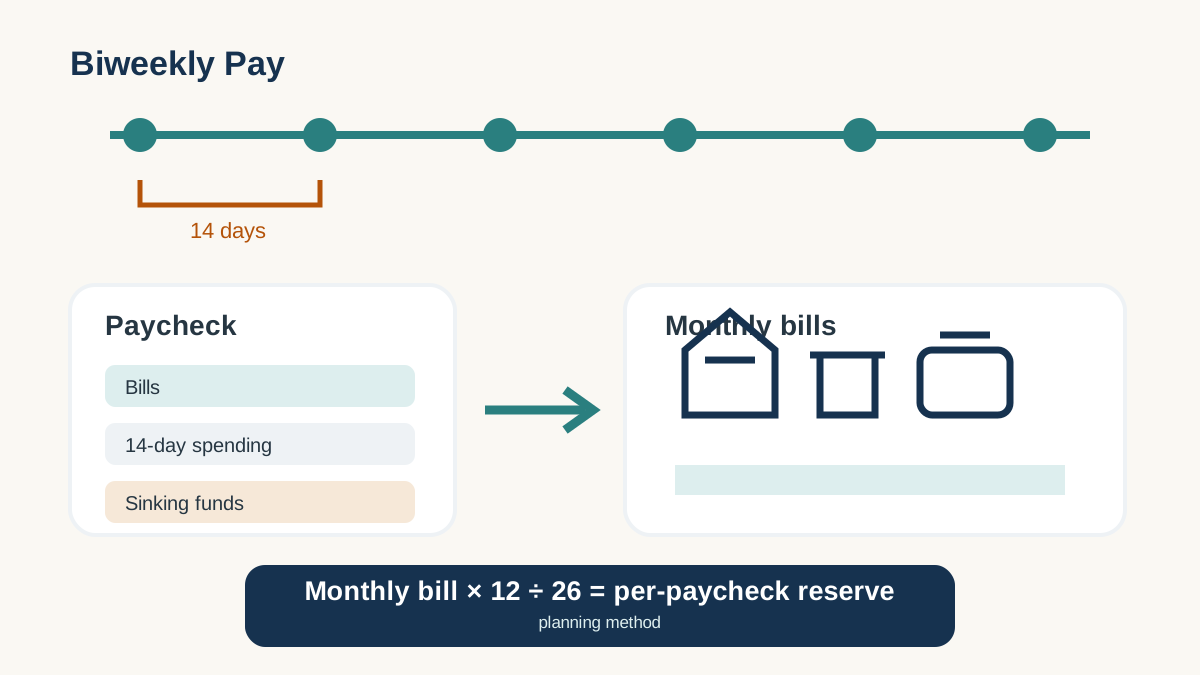
Getting paid every two weeks creates a simple timing problem: your income follows a 14-day cycle, while most household bills follow a monthly calendar.
That mismatch can make one paycheck feel overloaded and the next one feel unusually flexible, even when your total income has not changed.
A biweekly budget solves the timing problem by planning one paycheck at a time.
Instead of asking:
“Can this month’s income cover this month’s bills?”
ask:
“What must this paycheck cover before the next paycheck arrives?”
That change makes the cash-flow timing visible.
This guide uses straightforward math and planning. It does not assume a particular savings rate, debt strategy, or financial product.
Quick summary
Biweekly pay means one paycheck every two weeks, which produces 26 paychecks in a typical year.
A practical biweekly budget starts with a bill calendar, assigns each bill or bill reserve to a paycheck, gives 14-day spending categories a fixed role, and decides in advance how to use the two paychecks that fall outside a simple 24-paycheck, two-per-month baseline.
If your monthly bills are uneven, you can either assign whole bills to specific paychecks or reserve a portion of each bill from every paycheck.
Do not count a three-paycheck month as “free money” before deciding what job that paycheck has.
Biweekly is not the same as twice a month
The terms sound similar, but they produce different cash-flow patterns.
Biweekly pay:
- one paycheck every 14 days;
- usually 26 paychecks per year.
Twice-monthly or semimonthly pay:
- usually two fixed pay dates each month;
- usually 24 paychecks per year.
That difference matters because a biweekly payday moves through the calendar.
If you are paid every other Friday, the dates shift from month to month. Some months will contain two paychecks, and two additional paychecks appear across the year compared with a simple two-check-per-month plan.
Those extra paychecks are not bonuses in the employment sense. They are part of annual income that arrives on a different calendar pattern.
Step 1: Put paydays and bills on the same calendar
Use the site's Bill Calendar guide to put every expected payday, bill amount, and due date on one calendar. The goal here is not to rebuild that guide; it is to identify which bills must be funded before the next paycheck arrives.
Keep one view of:
- paycheck dates;
- recurring bills and due dates;
- automatic-payment dates;
- predictable non-monthly obligations.
Biweekly budget formula
For a fixed monthly bill you want to smooth across all 26 biweekly paychecks:
Monthly bill × 12 ÷ 26 = amount to reserve from each biweekly paycheck
Example:
$1,300 × 12 ÷ 26 = $600 per paycheck.
This is an arithmetic planning method, not a CFPB-required budgeting formula. If you are starting without a buffer, use your real due dates first and build the reserve method gradually.
Step 2: Choose your baseline budgeting method
There are two practical ways to fund monthly bills from biweekly paychecks.
You can use either one, or combine them.
Method A: Assign each bill to a paycheck
Each bill is assigned to the paycheck that arrives before its due date.
Example:
Paycheck A:
- rent reserve;
- electricity;
- internet;
- groceries for 14 days;
- transportation for 14 days.
Paycheck B:
- insurance;
- phone;
- childcare;
- groceries for 14 days;
- transportation for 14 days.
This works well when your bills are already spread fairly evenly across the month.
The weakness is that one paycheck can become overloaded if several large bills are due together.
Method B: Reserve part of each monthly bill from every paycheck
Instead of making one paycheck carry a full monthly bill, convert the bill into a per-paycheck reserve.
For a fixed monthly bill:
monthly bill × 12 ÷ 26 = amount to reserve from each biweekly paycheck
Example:
Monthly rent: $1,300
$1,300 × 12 = $15,600 per year
$15,600 ÷ 26 = $600 per biweekly paycheck
So a household using this method would reserve $600 from every paycheck toward rent.
This method smooths the annual cost across all 26 paychecks.
It can take time to set up if you are starting with no buffer, because a bill may be due before enough reserves have accumulated. In that case, begin with your current due-date reality and build the reserve system gradually rather than pretending the timing problem does not exist.
Step 3: Build a 14-day spending plan
Monthly categories can hide what happens between paychecks.
For variable expenses, it is often easier to budget for the exact period the paycheck must support.
Typical 14-day categories might include:
- groceries;
- fuel or transportation;
- household supplies;
- school or child expenses;
- personal spending;
- dining or entertainment.
The important question is:
“How much can this category use before the next paycheck?”
That is more actionable than a monthly number when you are making everyday decisions during a two-week pay period.
Step 4: Separate bills, spending, and sinking funds
A paycheck can have three different types of jobs.
Bills
Known obligations with due dates.
Examples:
- housing;
- utilities;
- insurance;
- phone;
- recurring debt payments.
14-day spending
Categories you expect to use between now and the next payday.
Examples:
- groceries;
- transportation;
- household spending.
Sinking funds
Money reserved for expenses that are predictable but not monthly.
Examples:
- annual insurance premium;
- car maintenance;
- school costs;
- gifts;
- yearly subscriptions;
- home maintenance.
Keeping these three groups separate makes it easier to see whether a tight paycheck is caused by monthly bills, ordinary spending, or a large irregular expense.
Step 5: Use a two-paycheck baseline for ordinary months
A simple way to reduce confusion is to build your regular monthly lifestyle around the income from two normal biweekly paychecks.
Why?
Because two paychecks are the pattern you can usually expect in most calendar months.
The additional paychecks that occur during the year can then be assigned separately instead of silently becoming part of normal monthly spending.
This does not mean you must save or invest those checks. It means you decide their purpose before they arrive.
Possible uses could include:
- building a bill buffer;
- funding sinking funds;
- replacing a major household item;
- paying an annual expense;
- catching up on a category that has a known shortfall;
- making an extra debt payment;
- leaving part as checking-account cushion.
The correct use depends on your household plan.
Step 6: Decide what the extra-paycheck periods will do before they arrive
With 26 biweekly paychecks, you receive two more paychecks per year than a 24-paycheck, twice-monthly schedule.
If you wait until those paychecks arrive to decide what they are for, they can easily disappear into normal spending.
Create a written rule ahead of time.
Example:
“When a third paycheck falls in a calendar month, first refill the bill buffer to $1,000, then fund the next annual insurance payment, then leave the remainder unassigned until the next budget review.”
That is only an example.
The useful part is the order of decisions.
Step 7: Handle variable monthly bills with a working estimate
Some bills change every month.
Examples:
- electricity;
- water;
- gas;
- variable childcare;
- usage-based services.
You have several options:
- budget from the current bill when it is already known;
- use a recent average and adjust when the bill arrives;
- reserve a slightly higher working amount if seasonal swings are common.
Do not treat an estimate as a guarantee.
If a bill is lower than expected, decide what happens to the difference. If it is higher, identify which category or buffer covers the gap.
Step 8: Be careful with automatic payments
Automatic payments can be convenient, but the timing still matters.
The CFPB notes that automatic debit payments pull money directly from an account based on an authorization.
For a biweekly budget, the key question is not only:
“Is this bill on autopay?”
It is:
“Will the money be in the account when the autopay runs?”
Add automatic payment dates to your bill calendar.
If an automatic payment can vary, keep enough room for the actual amount rather than budgeting only from a previous low bill.
A complete example
Assume a household receives:
$2,000 net every two weeks
This example is for math only.
Paycheck-level fixed reserves
Rent: $1,300 × 12 ÷ 26 = $600.00
Car insurance: $120 × 12 ÷ 26 ≈ $55.38
Internet: $70 × 12 ÷ 26 ≈ $32.31
Phone: $90 × 12 ÷ 26 ≈ $41.54
Total fixed reserves from each paycheck: about $729.23
14-day spending plan
Groceries: $300
Transportation: $120
Household/personal: $100
Total 14-day spending: $520
Sinking funds
Car maintenance: $60
Annual subscriptions: $25
Gifts: $30
Total sinking funds: $115
Total assigned so far
Fixed reserves: $729.23
14-day spending: $520
Sinking funds: $115
Total: $1,364.23
From a $2,000 paycheck, that leaves:
$635.77
That remainder still needs a job.
It might cover:
- other bills;
- childcare;
- savings;
- debt payments;
- irregular expenses;
- a checking buffer.
The point of the example is not the dollar amounts.
The point is that each paycheck is divided by purpose before money is spent.
What if one paycheck cannot cover its assigned bills?
First, separate a timing problem from an income problem.
A timing problem means the household can cover its obligations across the month, but too many bills fall before one paycheck.
Possible responses include:
- reserve part of large bills from both paychecks;
- build a one-paycheck buffer gradually;
- ask a biller whether a different due date is available;
- move a flexible category to the other paycheck.
An income shortfall is different. If total required spending exceeds available income, changing due dates will not solve the underlying gap.
The budget should make that difference visible.
A payday routine that takes about 10 minutes
On every payday:
- confirm the deposit amount;
- check bills due before the next payday;
- move or reserve bill amounts;
- fund 14-day spending categories;
- fund planned sinking funds;
- review automatic payments;
- check whether any expected expense changed;
- leave the remaining amount assigned, not accidental.
If something changed, update the current paycheck plan rather than rebuilding the entire year.
Common mistakes with biweekly budgeting
Mistake 1: Treating every month as exactly two paychecks
Biweekly pay runs on 26 checks, not 24.
If you ignore the extra two checks, the budget may not reflect annual income correctly.
Mistake 2: Averaging annual income into a monthly number and spending that amount every month
Annual income ÷ 12 can be useful for planning, but that average does not mean the money arrives evenly each month.
Cash-flow decisions should use actual deposit dates.
Mistake 3: Forgetting non-monthly bills
A budget can look balanced while annual and seasonal expenses are missing.
Use sinking funds for predictable irregular costs.
Mistake 4: Letting the third paycheck become unplanned spending
Decide its job before it arrives.
Mistake 5: Ignoring autopay timing
A category can be “budgeted” on paper while the bank account is still short on the withdrawal date.
How this fits with a zero-based budget
A biweekly budget and a zero-based budget are not competing systems.
A zero-based approach asks you to assign available income a job.
A biweekly approach decides when that assignment happens: every 14 days, around the actual paycheck.
You can use a zero-based monthly plan for the big picture and a biweekly paycheck plan for day-to-day cash flow.
A simple starting rule
If your current budget feels messy because payday and bill dates do not line up, start with one page:
Left side: every payday for the next eight weeks.
Right side: every bill due during the same period.
Then draw a line from each bill to the paycheck that will fund it.
That one exercise reveals where the timing problem actually is.
Once the timing is visible, you can decide whether to assign whole bills, split bills across paychecks, or build a buffer.
Related MoneyMethods tools and guides
Use this workflow with:
- How to Make a Bill Calendar Around Paydays;
- How to Start a Zero-Based Household Budget;
- How to Build and Use Sinking Funds;
- the Zero-Based Monthly Budget Worksheet;
- the Sinking-Fund Calculator.
The bill calendar shows when money is needed. The biweekly budget decides which paycheck will provide it.